 Add to Chrome
 Add to Firefox
 Add to Edge
MRI motion correction
Papers and Code
PERCEPT-Net: A Perceptual Loss Driven Framework for Reducing MRI Artifact Tissue Confusion
Apr 12, 2026
Purpose: Existing deep learning-based MRI artifact correction models exhibit poor clinical generalization due to inherent artifact-tissue confusion, failing to discriminate artifacts from anatomical structures. To resolve this, we introduce PERCEPT-Net, a framework leveraging dedicated perceptual supervision for structure-preserving artifact suppression. Method: PERCEPT-Net utilizes a residual U-Net backbone integrated with a multi-scale recovery module and dual attention mechanisms to preserve anatomical context and salient features. The core mechanism, Motion Perceptual Loss (MPL), provides artifact-aware supervision by learning generalizable motion artifact representations. This logic directly guides the network to suppress artifacts while maintaining anatomical fidelity. Training utilized a hybrid dataset of real and simulated sequences, followed by prospective validation via objective metrics and expert radiologist assessments. Result: PERCEPT-Net outperformed state-of-the-art methods on clinical data. Ablation analysis established a direct causal link between MPL and performance; its omission caused a significant deterioration in structural consistency (p < 0.001) and tissue contrast (p < 0.001). Radiologist evaluations corroborated these objective metrics, scoring PERCEPT-Net significantly higher in global image quality (median 3 vs. 2, p < 0.001) and verifying the preservation of critical diagnostic structures. Conclusion: By integrating task-specific, artifact-aware perceptual learning, PERCEPT-Net suppresses motion artifacts in clinical MRI without compromising anatomical integrity. This framework improves clinical robustness and provides a verifiable mechanism to mitigate over-smoothing and structural degradation in medical image reconstruction.

PSIRNet: Deep Learning-based Free-breathing Rapid Acquisition Late Enhancement Imaging
Apr 09, 2026Purpose: To develop and evaluate a deep learning (DL) method for free-breathing phase-sensitive inversion recovery (PSIR) late gadolinium enhancement (LGE) cardiac MRI that produces diagnostic-quality images from a single acquisition over two heartbeats, eliminating the need for 8 to 24 motion-corrected (MOCO) signal averages. Materials and Methods: Raw data comprising 800,653 slices from 55,917 patients, acquired on 1.5T and 3T scanners across multiple sites from 2016 to 2024, were used in this retrospective study. Data were split by patient: 640,000 slices (42,822 patients) for training and the remainder for validation and testing, without overlap. The training and testing data were from different institutions. PSIRNet, a physics-guided DL network with 845 million parameters, was trained end-to-end to reconstruct PSIR images with surface coil correction from a single interleaved IR/PD acquisition over two heartbeats. Reconstruction quality was evaluated using SSIM, PSNR, and NRMSE against MOCO PSIR references. Two expert cardiologists performed an independent qualitative assessment, scoring image quality on a 5-point Likert scale across bright blood, dark blood, and wideband LGE variants. Paired superiority and equivalence (margin = 0.25 Likert points) were tested using exact Wilcoxon signed-rank tests at a significance level of 0.05 using R version 4.5.2. Results: Both readers rated single-average PSIRNet reconstructions superior to MOCO PSIR for dark blood LGE (conservative P = .002); for bright blood and wideband, one reader rated it superior and the other confirmed equivalence (all P < .001). Inference required approximately 100 msec per slice versus more than 5 sec for MOCO PSIR. Conclusion: PSIRNet produces diagnostic-quality free-breathing PSIR LGE images from a single acquisition, enabling 8- to 24-fold reduction in acquisition time.
MR-Compass: Inertial Navigation-Driven Motion Correction for Brain MRI
Mar 02, 2026Inertial sensors can track object kinematics, however, unbounded drift from integrating noisy signals makes them impractical for MRI motion correction at millimeter resolution and minute-long scans. We introduce MR-Compass, which exploits the MRI system's static magnetic and gravitational fields to estimate 3-DOF orientation at 2 kHz directly, without integration, eliminating random-walk. The remaining 3-DOF translation is recovered via phase correlation from the MRI data. We experimentally validate the efficacy of the method retrospectively using a 3D radial koosh-ball sequence and prospectively using 2D EPI fMRI during large volunteer motions. MR-Compass followed by phase-correlation achieved a mean accuracy of 0.6$^o$ and 0.4 pixels across all experiments. Image quality improved when motion correction was applied in all volunteer scans for both retrospective and prospective correction cases. MR-Compass was effective in measuring head motion in the MRI scanner with high accuracy at unprecedented sample rates, and enabled both retrospective and prospective reconstruction to improve image quality by aligning the k-space data appropriately and by reducing the motion related artifacts.
High-fidelity 3D multi-slab diffusion MRI using Slab-shifting for Harmonized 3D Acquisition and Reconstruction with Profile Encoding Networks (SHARPEN)
Feb 06, 2026Three-dimensional (3D) multi-slab imaging is a promising approach for high-resolution in vivo diffusion MRI (dMRI) due to its compatibility with short TR (1-2 s), providing optimal signal-to-noise ratio (SNR) efficiency. A major challenge, however, is slab boundary artifacts arising from non-ideal slab-selective RF excitation. Non-rectangular slab profiles reduce signal intensity at slab boundaries, while profile overlap across adjacent slabs introduces inter-slab crosstalk, where repeated excitation shortens the local TR and limits T1 recovery. To mitigate slab boundary artifacts without increasing scan time, we build on slab profile encoding and propose Slab-shifting for Harmonized 3D Acquisition and Reconstruction with Profile Encoding Networks (SHARPEN). For different diffusion directions, SHARPEN applies inter-volume field-of-view shifts along the slice direction to provide complementary slab profile encoding without prolonging acquisition. Slab profiles are estimated using a lightweight self-supervised neural network that exploits consistency across shifted acquisitions and known physical properties of slab profiles and diffusion images, and corrected images are reconstructed accordingly. SHARPEN was validated using simulated and prospectively acquired high-resolution in vivo data and demonstrates accurate slab profile estimation and robust boundary artifact correction, even in the presence of inter-volume motion. SHARPEN does not require high-quality reference training data and supports subject-specific training. Its efficient GPU-based implementation delivers faster and more accurate correction than NPEN, yielding slice-wise quantitative profiles that closely match those from reference 2D acquisitions. SHARPEN enables high-quality dMRI at 0.7 mm isotropic resolution on a 3T clinical scanner, highlighting its potential to advance submillimeter dMRI for neuroscience research.
Retrospective motion correction in MRI using disentangled embeddings
Nov 11, 2025Physiological motion can affect the diagnostic quality of magnetic resonance imaging (MRI). While various retrospective motion correction methods exist, many struggle to generalize across different motion types and body regions. In particular, machine learning (ML)-based corrections are often tailored to specific applications and datasets. We hypothesize that motion artifacts, though diverse, share underlying patterns that can be disentangled and exploited. To address this, we propose a hierarchical vector-quantized (VQ) variational auto-encoder that learns a disentangled embedding of motion-to-clean image features. A codebook is deployed to capture finite collection of motion patterns at multiple resolutions, enabling coarse-to-fine correction. An auto-regressive model is trained to learn the prior distribution of motion-free images and is used at inference to guide the correction process. Unlike conventional approaches, our method does not require artifact-specific training and can generalize to unseen motion patterns. We demonstrate the approach on simulated whole-body motion artifacts and observe robust correction across varying motion severity. Our results suggest that the model effectively disentangled physical motion of the simulated motion-effective scans, therefore, improving the generalizability of the ML-based MRI motion correction. Our work of disentangling the motion features shed a light on its potential application across anatomical regions and motion types.
Fetpype: An Open-Source Pipeline for Reproducible Fetal Brain MRI Analysis
Dec 19, 2025Fetal brain Magnetic Resonance Imaging (MRI) is crucial for assessing neurodevelopment in utero. However, analyzing this data presents significant challenges due to fetal motion, low signal-to-noise ratio, and the need for complex multi-step processing, including motion correction, super-resolution reconstruction, segmentation, and surface extraction. While various specialized tools exist for individual steps, integrating them into robust, reproducible, and user-friendly workflows that go from raw images to processed volumes is not straightforward. This lack of standardization hinders reproducibility across studies and limits the adoption of advanced analysis techniques for researchers and clinicians. To address these challenges, we introduce Fetpype, an open-source Python library designed to streamline and standardize the preprocessing and analysis of T2-weighted fetal brain MRI data. Fetpype is publicly available on GitHub at https://github.com/fetpype/fetpype.
Systematic Review and Meta-analysis of AI-driven MRI Motion Artifact Detection and Correction
Sep 05, 2025Background: To systematically review and perform a meta-analysis of artificial intelligence (AI)-driven methods for detecting and correcting magnetic resonance imaging (MRI) motion artifacts, assessing current developments, effectiveness, challenges, and future research directions. Methods: A comprehensive systematic review and meta-analysis were conducted, focusing on deep learning (DL) approaches, particularly generative models, for the detection and correction of MRI motion artifacts. Quantitative data were extracted regarding utilized datasets, DL architectures, and performance metrics. Results: DL, particularly generative models, show promise for reducing motion artifacts and improving image quality; however, limited generalizability, reliance on paired training data, and risk of visual distortions remain key challenges that motivate standardized datasets and reporting. Conclusions: AI-driven methods, particularly DL generative models, show significant potential for improving MRI image quality by effectively addressing motion artifacts. However, critical challenges must be addressed, including the need for comprehensive public datasets, standardized reporting protocols for artifact levels, and more advanced, adaptable DL techniques to reduce reliance on extensive paired datasets. Addressing these aspects could substantially enhance MRI diagnostic accuracy, reduce healthcare costs, and improve patient care outcomes.
Reliable Evaluation of MRI Motion Correction: Dataset and Insights
Jun 06, 2025Correcting motion artifacts in MRI is important, as they can hinder accurate diagnosis. However, evaluating deep learning-based and classical motion correction methods remains fundamentally difficult due to the lack of accessible ground-truth target data. To address this challenge, we study three evaluation approaches: real-world evaluation based on reference scans, simulated motion, and reference-free evaluation, each with its merits and shortcomings. To enable evaluation with real-world motion artifacts, we release PMoC3D, a dataset consisting of unprocessed Paired Motion-Corrupted 3D brain MRI data. To advance evaluation quality, we introduce MoMRISim, a feature-space metric trained for evaluating motion reconstructions. We assess each evaluation approach and find real-world evaluation together with MoMRISim, while not perfect, to be most reliable. Evaluation based on simulated motion systematically exaggerates algorithm performance, and reference-free evaluation overrates oversmoothed deep learning outputs.
Non-rigid Motion Correction for MRI Reconstruction via Coarse-To-Fine Diffusion Models
May 21, 2025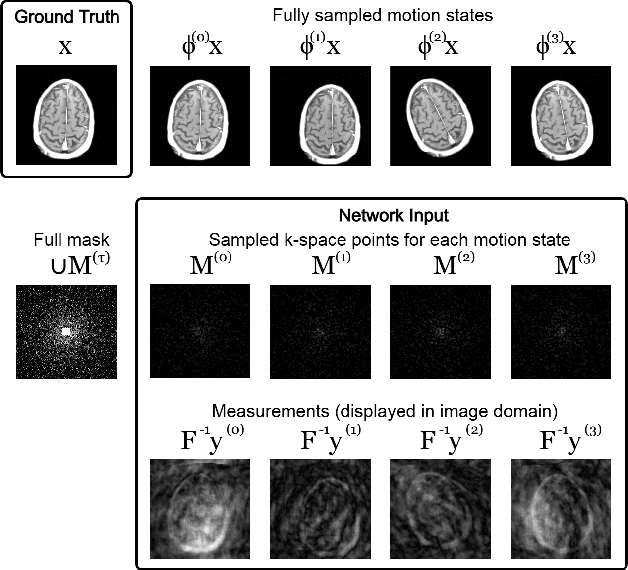
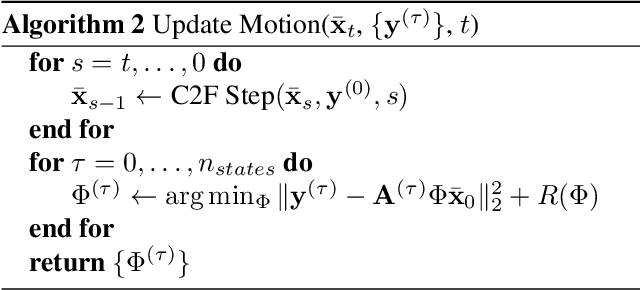
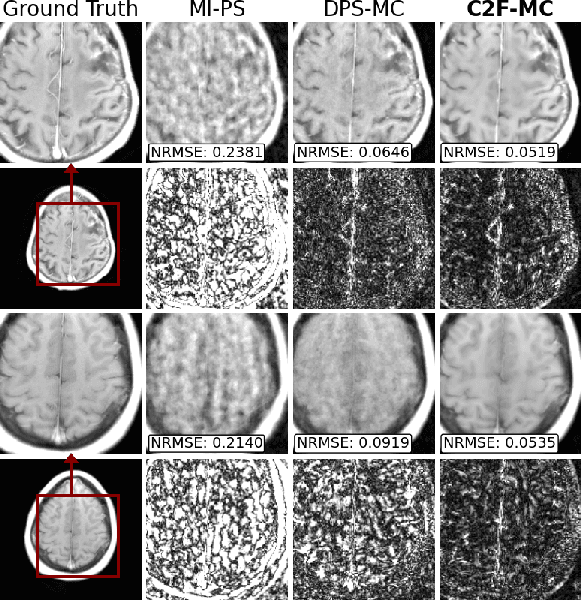
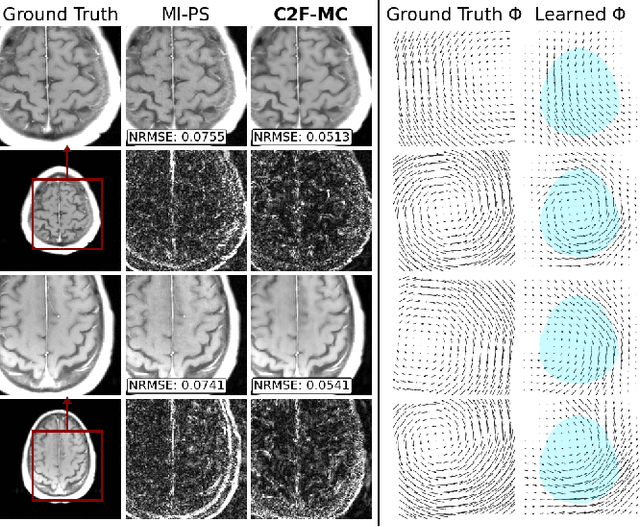
Magnetic Resonance Imaging (MRI) is highly susceptible to motion artifacts due to the extended acquisition times required for k-space sampling. These artifacts can compromise diagnostic utility, particularly for dynamic imaging. We propose a novel alternating minimization framework that leverages a bespoke diffusion model to jointly reconstruct and correct non-rigid motion-corrupted k-space data. The diffusion model uses a coarse-to-fine denoising strategy to capture large overall motion and reconstruct the lower frequencies of the image first, providing a better inductive bias for motion estimation than that of standard diffusion models. We demonstrate the performance of our approach on both real-world cine cardiac MRI datasets and complex simulated rigid and non-rigid deformations, even when each motion state is undersampled by a factor of 64x. Additionally, our method is agnostic to sampling patterns, anatomical variations, and MRI scanning protocols, as long as some low frequency components are sampled during each motion state.
MRI motion correction via efficient residual-guided denoising diffusion probabilistic models
May 06, 2025Purpose: Motion artifacts in magnetic resonance imaging (MRI) significantly degrade image quality and impair quantitative analysis. Conventional mitigation strategies, such as repeated acquisitions or motion tracking, are costly and workflow-intensive. This study introduces Res-MoCoDiff, an efficient denoising diffusion probabilistic model tailored for MRI motion artifact correction. Methods: Res-MoCoDiff incorporates a novel residual error shifting mechanism in the forward diffusion process, aligning the noise distribution with motion-corrupted data and enabling an efficient four-step reverse diffusion. A U-net backbone enhanced with Swin-Transformer blocks conventional attention layers, improving adaptability across resolutions. Training employs a combined l1+l2 loss, which promotes image sharpness and reduces pixel-level errors. Res-MoCoDiff was evaluated on synthetic dataset generated using a realistic motion simulation framework and on an in-vivo dataset. Comparative analyses were conducted against established methods, including CycleGAN, Pix2pix, and MT-DDPM using quantitative metrics such as peak signal-to-noise ratio (PSNR), structural similarity index measure (SSIM), and normalized mean squared error (NMSE). Results: The proposed method demonstrated superior performance in removing motion artifacts across all motion severity levels. Res-MoCoDiff consistently achieved the highest SSIM and the lowest NMSE values, with a PSNR of up to 41.91+-2.94 dB for minor distortions. Notably, the average sampling time was reduced to 0.37 seconds per batch of two image slices, compared with 101.74 seconds for conventional approaches.